Patient-specific quality assurance (PSQA) must ensure the highest level of accuracy while operating within limited resources. For many years, PSQA relied exclusively on measurement-based methods, and the detectors and phantoms developed for this purpose have played a decisive role in shaping dosimetric quality assurance in radiation therapy. Software-based approaches for independent secondary dose calculation provide additional options. This article outlines how PSQA has evolved, which methods are available today, and how their targeted use can be combined into a robust and efficient quality assurance system.
PSQA: Measurement-Based or Software-Based?
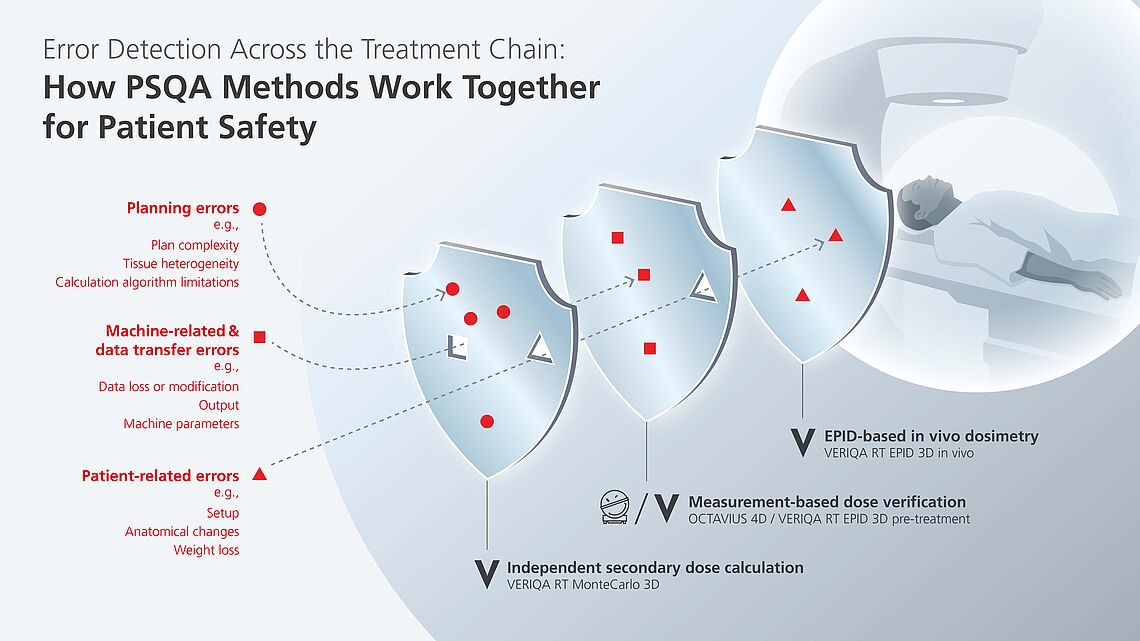
The purpose of PSQA is to detect errors and provide insight into their causes. Potential errors in radiation therapy may arise in four main areas: in addition to planning errors, transfer errors, machine-related errors, and, not least, patient-specific errors can occur. The latter can only be reliably detected during patient treatment, for example through EPID in vivo dosimetry.
According to established guidelines and recommendations (DIN 6875-3 or AAPM TG-218/TG-219), pre-treatment dose verification can be performed either through measurements (e.g., using a phantom or EPID) or through dose recalculations. However, the two approaches differ significantly in terms of accuracy and required effort.
Historically, PSQA was based exclusively on measurement-based methods: initially using film, followed by ionization chambers, and today employing sophisticated detector array systems and phantoms such as OCTAVIUS by PTW. These methods require manual procedures and are therefore time- and resource-intensive. Nevertheless, they remain an important reference standard for dosimetric quality assurance of both patient treatments and linear accelerators.
Digital, software-based solutions for independent secondary dose calculation are becoming increasingly important. At the center of this development is the Monte Carlo algorithm.
Independent Dose Recalculation with Monte Carlo
Independent secondary dose calculations automatically recalculate a treatment plan and compare the result with the primary dose calculation, without requiring additional machine time or staff effort. Clinically unremarkable plans that pass the secondary calculation generally do not require further review by the medical physics team.
The proportion of plans that pass stringent acceptance criteria depends strongly on the algorithm used. Analytical methods exhibit greater variability, resulting in a higher number of false alarms that must subsequently be reviewed manually. In contrast, Monte Carlo (MC) algorithms provide greater accuracy while requiring no additional effort.
A study published in 2025 by Hoffmann et al. [1] in the Journal of Applied Clinical Medical Physics compared the MC algorithm SciMoCa, as implemented in PTW’s VERIQA RT MonteCarlo 3D, with the analytical algorithm used in Mobius3D. While the latter showed dose differences of up to 6% and gamma pass rates as low as 30%, SciMoCa achieved pass rates exceeding 95% and demonstrated only minor variability, with deviations remaining close to the acceptance threshold. The study concluded that MC-based dose recalculation provides a significant clinical benefit for PSQA and enables substantially more stringent acceptance criteria while reducing verification effort.
EPID Dosimetry: Dose Verification Before and During Patient Treatment
EPID dosimetry can be used in two distinct ways: before treatment (“pre-treatment”) and during treatment (“in vivo”).
For pre-treatment plan verification, EPID dosimetry with VERIQA RT EPID 3D pre-treatment provides a fast and efficient solution without the need for phantom setup.
EPID-based in vivo dosimetry with VERIQA RT EPID 3D captures the dose actually delivered during each fraction, enabling continuous monitoring of the entire treatment delivery chain, including patient-specific factors such as anatomical changes or positioning deviations. Errors arising after plan verification become visible and quantifiable.
Not Every Method Fits Every Plan
The availability of software-based approaches expands the PSQA toolkit but does not completely replace measurement-based methods. Phantom measurements, independent dose recalculations, and EPID dosimetry each have distinct strengths, address different error sources, and vary in the effort required. Their areas of application overlap only partially, and it is precisely this limited overlap that creates their complementary value.
Monte Carlo dose recalculations evaluate the treatment plan in the background without additional effort and provide fast, accurate dose verification before treatment. They primarily detect planning-related errors but can be applied automatically to every plan.
Pre-treatment EPID dosimetry extends this approach by additionally accounting for transfer-related and machine-related errors. EPID-based in vivo dosimetry further identifies deviations that arise only during treatment delivery to the patient.
When a measurement is required, either EPID-based measurements or conventional phantom measurements with OCTAVIUS may be selected, depending on the application. Both approaches have a well-defined role within a comprehensive PSQA program. EPID-based measurements with VERIQA RT EPID pre-treatment do not require phantom setup and are well suited for standard treatment plans and routine applications. In contrast, phantom measurements with OCTAVIUS remain indispensable for very large treatment fields, off-axis or non-coplanar fields, and complex stereotactic treatments with demanding dosimetric requirements.